Monday, February 7, 2011

Treasures of Todai-ji's Omizutori Ritual

People say Omizutori or Water Drawing Ritual at the Todaiji Temple brings spring to Nara.

An exhibition focusing on Omizutori Ritual is held in Nara National Museum. As well as paintings and documents showing history of and people's faith in Omizutori Ritual, equipment used during the ritual are on display. My favourite exhibit is Kamiko, a paper-made clothe wore and handmade by monks attending the ritual.

Omizutori Ritual is one of the most tourist popular rituals held annually in Nara. Visit the museum before going to the ritual to enjoy it more. Of course, joining a Nara Walk tour and listing histories and stories about Omizutori Ritual would enhance your experience even more!


Duration: ~2011.3.14
Closed on Mondays except for Feb. 14, Mar. 7 and Mar. 14.
Hours: 9:30~17:00
*Feb.8-14 till 21:00, Mar.1-11 till 18:00, Mar. 12 till 19:00, Mar. 13 and 14 till 18:00
*Entrance permitted until 30 min before the closing time.
Admission: Adults 500yen, Univ. Students 250yen
*Seniors(70 and older) and those 18 and under are free.
*Half price off for married couples on Feb. 22.
Access: click here

*****
Omizutori Ritual will be held from Mar.1 to 14 in Todaiji Temple.

Sue
-NARAWALK guide

Sunday, February 6, 2011

Morimura Yasumasa A Requiem: Art on Top of the Battlefield


What was your 20th century like?

Morimura Yasumasa is an artist known for self-portrait photos in which he poses as models in famous paintings or movie actresses. In an exhibition titled "A Requiem: Art on Top of the Battlefield" held at Hyogo Prefectural Museum of Art, Morimura poses as famous male figures from the 20th century. Albert Einstein, Adolf Hitler, Guevara, and Mishima Yukio in the poster above are all Morimura.


What will you make of his requiem of the 20th century?

Duration: ~2011.4.10
Closed on Mondays(except for March 21) and on March 22
Hours:
Sunday to Thursday 10:00-18:00 (entrance permitted until 17:30)/
Friday and Saturday 10:00-20:00 (entrance permitted until 19:30)

Admission: Adults 12ooyen, University Students 900yen, Seniors(65 and older) and High School Students 600yen, Junior High School and Elem. School Students are Free
Access: click here

Sue
-NARAWALK guide

Monday, January 31, 2011

Events around Deer Park (Feb. 2011)

Around Nara Park:

Feb.1(tue)- March 10(thr) Shika-yose (Deer Herding)

With a sound of horn deer gathers to get feeds. Horn plays the Pastoral Symphony by Beethoven.

10:00~10:15 @Tobihino Field (open field near the main approach of Kasuga Grand Shrine)

Feb. 3(thr) Setsubun

Setsubun is a day before a new season, but in general it refers to only one day – the eve of spring. At the turn of seasons evils are believed to come out. On Setsubun beans are scattered through out the country to drive away evils.

@February Hall in Todaiji Temple

14:00 ~ Scattering Beans.

18:00~ Hoshikuyo – a ritual to pray upon one’s guardian stars for peace and happiness of that year. 135 stone lanterns along the way from near Great Buddha Hall to February Hall are lit.


@Tamukeyama Hachiman Shrine (in the precinct of Todaiji Temple)

11:00~ Onda Festival – a ritual to pray for agricultural fertility. In this ritual, rice planting process is performed in Noh style. Afterwards beans are scattered.


@Kofukuji Temple

18:30~ A ritual ceremony to pray for peace and happiness

19:00~ Driving away demons and scattering beans


@Kasuga Grand Shrine

17:30~ Offertory of Bugaku, traditional Japanese court music and dances

18:00~ All 3000 lanterns are lit.

*With donation of 3000yen or more, you can light up a lantern by yourself.

20:30 Gates closed.


@Gangoji Temple

12:00~ Ceremony in the Main Hall

13:00~ Homa Ritual and Ascetic Training (walking over fire)

*You can join the ascetic training of walking over fire if you wish.

15:00~ Scattering Beans


@Daianji Temple

14:00~ Homa Ritual

15:00~ Scattering Beans

*Amazake, sweet low-alcoholic drink, is offered to visitors.


Feb. 8(tue) Special Viewing of Kannon Bodhisattva

10:00~17:00 @ Jiganji Temple (10min walk from Kintetsu Nara Station)

This Kannon Bodhisattva statue is open to the public twice a year. A ceremony is held from 8:00.

Feb. 8(tue)-Feb. 14(mon) Nara Rurie

During Nara Rurie, Todaiji Temple, Kofukuji Temple and Kasuga Grand Shrine are open till 20:30. Pathways connecting these three locations are illuminated by various lanterns ranging from traditional stone lanterns to modern artistic lanterns.

*Light-up and Night Time Opening Hours*

=Light-ups & illumination: 17:30 – 20:30

=Fireworks: around 18:00 (*only on Feb. 8)

=Todaiji Temple: 17:30 – 20:30

March Hall is open. *Great Buddha Hall is not open.

Free live music at near by Ukigumo-enchi Park starting 19:00 on Feb 8.

=Kofukuji Temple: 17:30 – 20:30

Eastern Golden Hall and Kofukuji National Treasure House are open.

Five Storied Pagoda is lit up.

=Kasuga Grand Shrine: 17:30 – 20:30

Main shrine is open. All lanterns are lit. There are about 3000 lanterns.

Free live music at Manyo Botanical Garden starting 19:00 on Feb 9 and 10. Feb 10 is traditional Japanese music. Garden is located along the main approach.

Nara National Museum is also open till 21:00 (*but enter before 20:30).

Feb. 15(tue) Nehan-e

February 15 is the day Sakyamuni Buddha died and entered nirvana or Nehan. Ritual ceremonies are held to commemorate this day.

10:00~ @ Honbo in Kofukuji Temple

*Amazake, sweet low-alcoholic drink, is offered to visitors.


Around Horyuji and Nishino-kyo:

Feb. 1(tue) – 3(thr) Syuni-e

Syuni-e literary means “a ritual ceremony held in February”. On behalf of all the people, monks repent sins to Buddha. Some Syuni-e are held in March following the lunar calendar.

@ Saiendo Hall in Horyuji Temple

(Feb.1&2) 13:00~ / (Feb.3) 17:00~ Syuni-e

(Feb.3) 19:00~ Tsuina-siki

*Tsuina means “driving away evils”. In this ceremony three demon figures are drove out from the Hall.

Feb.5(sat) Sanzo-e

10:00~ @ Sanzoin Hall in Horyuji Temple

A ceremony is held to commemorate Sanzo or Xuanzang, a famous Chinese Buddhist monk. He is also popularly known as one of fictional heroes of “Journey to the West” or “Monkey”.

Feb. 11(fri) Sunakake Festival

@ Hirose Shrine (30min walk or 10min drive from JR Horyuji Station)

This is a festival to pray for agricultural fertility. The highlight of this festival is Sunakake – that is throwing and pouring sands at each other. Visitors are welcome to join in Sunakake. Sand symbolizes rain - harder the sand throwing, greater the rainfall and thus richer the harvest.

11:00~ Ceremoney – rice planting play like ceremoney

13:30~ Offertory of Drum Music

14:00~ Sunakake (done 8 times, each is 5 min long)

Feb. 15(tue) Nehan-e

February 15 is the day Sakyamuni Buddha died and entered nirvana or Nehan. Ritual ceremonies are held to commemorate this day.

@ Raido Hall in Toshodaiji Temple

13:30~@ Daikodo in Horyuji Temple


Sue
-NARAWALK guide

Wednesday, January 26, 2011

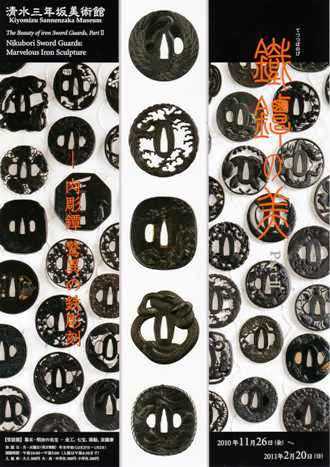
The Beauty of Iron Sword Guards

Look at the picture. What do you think they are? (for larger view click here) Hint ... samurai warrior.


This is a picture of iron sword guards. They are exhibited at Kiyomizu Sannenzaka Museum in Kyoto. Have a close look at them, and find out their elaborate designs and how fashionable samurai warriors were to the detail!

Duration: ~2011.2.20
Time:10:00-17:00(enter before 16:30)
Admission: Adults 500yen, Students (with ID) 300yen, Children(6-12 years old) 200yen, Children under 5 years old are free
Access : click here

~from the exhibition's poster~
Iron sword guards are made by poring melting iron into molds ... that is what many people think. Not true for most of them. Iron sword guards making is much like that of sword blades, formed through numerous heating and hammering. Hardened guard bodies are then sculpted using chisels and hammers.

Sculpting a hardened iron takes a great endeavour. It would take a few weeks to make one iron sword guard, one to two months if the design requires fine, detailed sculpting. Iron sword guards with relief are marvelous iron sculptures.

Enjoy this exhibition, and do remember while enjoying the difficulty and perseverance of sculpting hardened irons.
~~

Sue
-NARAWALK guide

Saturday, January 22, 2011

57 Stages of the Tokaido


Reading the title, if you thought "Wasn't it 53 Stages of the Tokaido that Hiroshige, the ukiyo-e artist, created?" - you are right. "57 Stages of the Tokaido" is an exhibition held now in Mikimoto Pearl Island.

Hiroshige's 53 Stages of the Tokaido depicts 53 stages along Tokaido, a road connecting Edo (current Tokyo) and Kyo (current Kyoto) . 4 more stages of Kyokaido, a road connecting Kyo and Osaka, was added to Tokaido to connect Edo (political centre) and Osaka(economic centre) in 1619 - creating 57 stages to Tokaido.

In "57 Stages of the Tokaido", Kogen Mizutani recreates Hiroshige's "53 Stages of the Tokaido" using various seashells. Mizutani is Japan's leading seashell craftsman. 5 original works depicting stages of Kyokaido and the terminal Kyobashi in Osaka are exhibited too. This exhibition also marks a completion of his 14 years long work on recreating stages of Tokaido.


Place: Pearl Museum in Mikimoto Pearl Island(Access)
Duration: ~2011.4.3
Hours: 8:30~17:00(Jan. to March), 8:30~17:30(April to Oct)
Admission (for Mikimoto Pearl Island): Adults 1500yen, Elementary & Junior High School students 750yen

Sue
-NARAWALK guide

Thursday, January 13, 2011

Spirit of Ink and Brush

One of my homework during winter vacation back in my elementary school days was to write down a New Year's resolution using ink and brush. I don't write it with ink and brush anymore, but New Year reminds me of ink and brush.

The most celebrated artist of ink brush is Wang Xizhi(303-361). He is a Chinese calligrapher lived in Jin Dynasty, and also known as the Sage of Calligraphy.

In Kyoto National Museum, an exhibition titled "Spirit of Ink and Brush - the World of Chinese Paintings and Calligraphies" is held. In this exhibition 110 works of calligraphy and Chinese paintings, including 10 National Treasures and 23 Important Cultural Properties, are on display. Works of Wang Xizhi are included too!


Duration: ~2011.2.20
Closed on Mondays
Hours: 9:30 a.m.-6:00 p.m. (Entrance Until 5:30 p.m.)
Fridays 9:30 a.m.-8:00 p.m. (Entrance Until 7:30 p.m.)
Admission: Adults 1200yen, High School/Univ. Students 800yen, Elem./Junior High Sch. Students 400yen

*****
Ink is one of Nara's traditional industry. Including more than 400 years old Ink company, Kobaien, you will walk by several ink and brush shops in our daily tours.

Sue
-NARAWALK guide


Saturday, January 1, 2011

A Happy New Year


A Happy New Year to Everyone!

Many thanks to all the guests who attended Nara Walk tour last year. And to the guests we may meet this year... we hope to serve you soon!

This year is a year of RABBIT. A year of Rabbit is said to be a year of advancement. A rabbit's jumping ability may be one of the reason to think this way.

What happened in the past years of rabbit?
In 1903, year of rabbit, the first Tour de France was held. The same year the Ford Motors was established. The same year the Wright brothers succeeded in their first flight. In 1927, year of rabbit, BBC was established. The same year Charles Lindbergh succeeded in the world's first nonstop flight across the Atlantic. 1975, year of rabbit, Microsoft was established. 1999, year of rabbit, Euro started.


Sue
-NARAWALK guide
Related Posts Plugin for WordPress, Blogger...